
Imagine you want to buy a new toy.
You walk into a big toy store and see hundreds of toys everywhere. Cars, dolls, robots, puzzles , so many choices that it becomes hard to decide which one to pick.
Now imagine three different things helping you choose the toy:
1. A cool kid on the playground tells you which toy is fun.
2. A smart robot shows you toys it thinks you will like.
3. Your friends tell you if the toy is actually good.
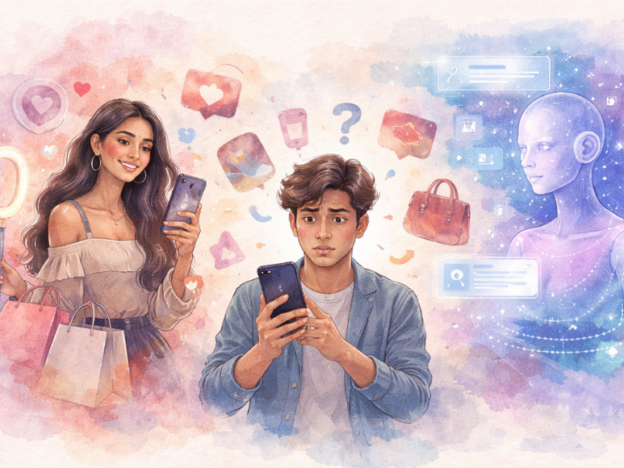
This is very similar to how people in India decide what to buy today. In the past, companies used television advertisements and big celebrities to tell people what to buy. But today, things are different. In the digital world, people are influenced by three powerful forces: social media influencers, artificial intelligence (AI), and recommendations from friends and communities.
So the big question marketers ask today is: Who really controls consumer decisions today?
The answer is not just one group. Instead, it is a combination of human influence, smart technology, and social trust.
The Cool Kid on the Internet: Influencers
Let’s go back to the playground example.
Imagine there is a kid everyone likes and listens to. If that kid says, “This toy is really fun,” many other kids want the same toy too. That is exactly how influencers work on the internet.
Influencers are people who create content online and have many followers. They post videos, photos, or reviews about products they like. Their followers watch these videos and often trust their opinions. Apps like Instagram and YouTube have made influencers extremely powerful.
When an influencer shows a skincare routine, a new smartphone, or a restaurant they like, thousands or sometimes millions of people watch it.
Because influencers feel relatable, people trust them more than traditional advertisements. Instead of seeing a perfect celebrity in a polished advertisement, viewers see a real person using the product in everyday life.
This is why influencer marketing has grown very fast in India. Interestingly, many young people do not always trust big celebrities anymore. Instead, they prefer micro-influencers—creators with smaller audiences but stronger connections with their followers. For example, a small creator reviewing a budget phone or a local café may feel more honest than a huge Bollywood star promoting an expensive product.
In today’s world, authenticity feels more powerful than fame.
The Invisible Robot: Artificial Intelligence
Now imagine something else is happening behind the scenes. There is an invisible robot that decides which toys you see in the store.
If you like cars, the robot shows you more car toys.
If you like puzzles, it shows you puzzles.
That robot is similar to artificial intelligence, or AI.
AI systems are used by social media platforms to decide what content appears on your screen. These systems study your behavior very carefully.
They notice:
1. which videos you watch
2. which posts you like
3. how long you stay on a video
4. what you search for
Based on this information, the algorithm decides what to show you next.This means that even though influencers create content, AI decides whether their content reaches you.
For example, if you watch many food videos, the algorithm will show you more cooking channels and restaurant reviews. If you watch tech videos, you will start seeing more smartphone reviews and gadget comparisons.
This is why two people using the same app can see completely different content.
Because influencers feel relatable, people trust them more than traditional advertisements. Instead of seeing a perfect celebrity in a polished advertisement, viewers see a real person using the product in everyday life.
This is why influencer marketing has grown very fast in India. Interestingly, many young people do not always trust big celebrities anymore. Instead, they prefer micro-influencers—creators with smaller audiences but stronger connections with their followers. For example, a small creator reviewing a budget phone or a local café may feel more honest than a huge Bollywood star promoting an expensive product.
In today’s world, authenticity feels more powerful than fame.
The Invisible Robot: Artificial Intelligence
Now imagine something else is happening behind the scenes. There is an invisible robot that decides which toys you see in the store.
If you like cars, the robot shows you more car toys.
If you like puzzles, it shows you puzzles.
That robot is similar to artificial intelligence, or AI.
AI systems are used by social media platforms to decide what content appears on your screen. These systems study your behavior very carefully.
They notice:
1. which videos you watch
2. which posts you like
3. how long you stay on a video
4. what you search for
Based on this information, the algorithm decides what to show you next.This means that even though influencers create content, AI decides whether their content reaches you.
For example, if you watch many food videos, the algorithm will show you more cooking channels and restaurant reviews. If you watch tech videos, you will start seeing more smartphone reviews and gadget comparisons.
This is why two people using the same app can see completely different content.
AI also helps companies understand customers better. Brands use AI tools to:
1. study consumer behavior
2. predict future trends
3. target advertisements more accurately
4. choose the right influencers for campaigns
Because of AI, marketing has become much more personalized. Instead of everyone seeing the same advertisement, people see ads that match their interests.
In simple words, influencers may talk about products, but AI decides who hears the message.
The New Experiment: AI Influencers
Technology has become so advanced that companies have even started creating AI influencers.
These are digital characters created using artificial intelligence. They look like real people but are completely controlled by computers and designers.
Unlike human influencers, AI influencers never get tired, never age, and never get involved in scandals. They can create content anytime and follow a brand’s message perfectly.
For brands, this sounds very attractive.
However, many consumers still feel unsure about trusting completely artificial personalities. People usually connect better with real humans who share real experiences and emotions.
Because of this, AI influencers are likely to support human influencers rather than replace them completely.
The Most Powerful Influence: Friends
Even though influencers and AI are very powerful, the biggest influence may still come from something simple friends and communities. Think about how people usually make decisions.
Someone might see a sneaker recommended by an influencer online. It looks cool, and the video makes it seem exciting.
But before buying it, the person might ask their friends:
“Do you think this brand is good?”
“Has anyone tried this?”
They might also read reviews or check comments online.
If friends say the product is good, the person feels more confident about buying it. If friends say it is not worth the money, they may change their mind.
This shows that peer trust is extremely powerful.
Even in the digital world, people still rely heavily on the opinions of people they know and trust.
In many cases, influencers start the conversation about a product—but friends and communities help make the final decision.
So Who Really Controls Consumer Decisions?
When we look at India’s digital world today, consumer decisions are shaped by three different forces working together.Influencers introduce products and show how they work in real life. They make products feel relatable and exciting.AI algorithms decide which content people see. They personalize feeds and advertisements based on user behavior.Social Circles Friends, reviews, and online communities help confirm whether a product is actually worth buying.
Instead of one single person controlling decisions, consumer behavior is shaped by an entire ecosystem.
The Future of Consumer Influence in India
As technology continues to grow, the way people make decisions will keep changing.
Three major trends are shaping the future:
First, AI-powered personalization will become even stronger. Marketing messages will become more tailored to individual users.
Second, micro-influencers and niche creators will continue gaining popularity because audiences value authenticity and honesty. Third, trust and transparency will become more important than ever. Young consumers, especially Gen Z, are very aware of marketing tactics. They quickly notice when a brand is being fake or dishonest.
Brands that build genuine connections with their audiences will be more successful.